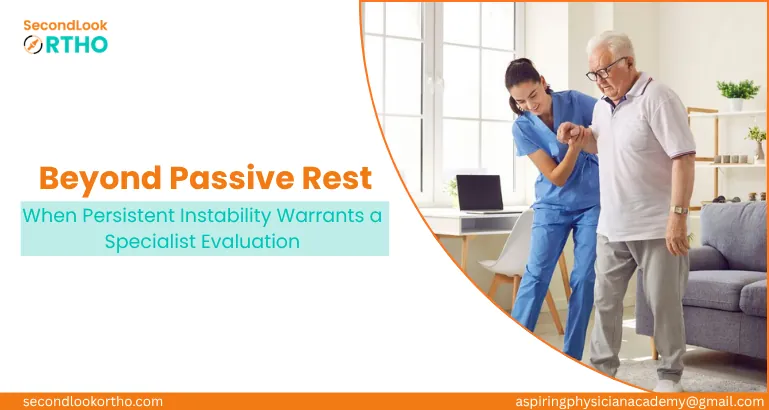
Why Resting Your Knee Isn't Solving Instability and When to Consult a Specialist
If you have recently suffered a knee injury, your first instinct was likely to follow the age-old advice “Rest, Ice, Compression, and Elevation”. This is known as the R.I.C.E. protocol. For many, this formula is the gold standard for the first 48 hours. You sit on the couch, the swelling goes down, and the sharp pain fades.
But then you stand up. You try to walk down a flight of stairs or turn a corner quickly, and your knee feels off. It feels loose, wobbly, or like it might buckle. If you are resting but still feeling persistent knee instability, you are likely dealing with a structural issue that ice packs cannot fix.
Beyond the R.I.C.E. Protocol: Why Resting Your Knee Isn't Solving Instability and When to Consult a Specialist

If you have recently suffered a knee injury, your first instinct was likely to follow the age-old advice “Rest, Ice, Compression, and Elevation”. This is known as the R.I.C.E. protocol. For many, this formula is the gold standard for the first 48 hours. You sit on the couch, the swelling goes down, and the sharp pain fades.
But then you stand up. You try to walk down a flight of stairs or turn a corner quickly, and your knee feels off. It feels loose, wobbly, or like it might buckle. If you are resting but still feeling persistent knee instability, you are likely dealing with a structural issue that ice packs cannot fix.
Why Rest Can Sometimes Be a Trap
In 2026, orthopedic science has shifted. We now know that while rest helps with inflammation, prolonged inactivity can actually make an injury worse. When you stop moving, your quadriceps and hamstrings the muscles that act as a natural brace for your joint begin to weaken (atrophy) in as little as 48 hours.
Without these muscles firing correctly, a minor knee injury can turn into a chronic problem because the joint no longer has its secondary support system. This is why many patients feel like they are stuck in a cycle of feeling better while sitting, but feeling unstable the moment they return to activity.
The 3 Hidden Causes of Instability
When a knee feels untrustworthy after the initial pain is gone, it is usually due to one of these three factors that rest alone cannot repair:
-
Micro-Instability from Ligament Laxity: Even a Grade 1 ACL injury or MCL sprain can leave the ligament slightly stretched. Like a loose rubber band, it no longer holds the bones in perfect alignment during a twist or turn.
-
Proprioceptive Loss: Your knee is full of tiny sensors that tell your brain where your leg is in space. After an injury, these sensors go quiet. Passive rest won't reactivate your joints natural sensors; only precise, targeted movement can restore that vital brain to knee connection.
-
Meniscal Mechanical Interference: A small, painless tear in the meniscus can act like a pebble in a shoe. It doesn’t always hurt, but it causes the joint to slip or catch unexpectedly.
For those looking for Fast Knee Pain Relief, the goal must shift from avoiding pain to restoring stability.
When to Seek a Second Look
Many patients are told by general doctors to just give it time. But if you are an active person, time is not a treatment plan. You should seek a specialist second opinion if:
-
Your knee gives way during simple tasks like walking on uneven grass.
-
You feel a shifting sensation when you change directions.
-
You are confused about whether you need ACL Surgery Or Can You Heal?
At SecondLookOrtho, we specialize in these gray area cases. We use 2026 standard diagnostic tools to see what the first look might have missed. Our goal is to give you a definitive path forward so you are not just waiting to get better, but actively healing.
Moving Beyond the Couch
The R.I.C.E. protocol is a great start, but it is not a finish line. True recovery requires a balance of protection and progressive loading. If your knee still feels like it belongs to someone else, it's time to stop guessing and start getting answers.
Your movement is your freedom. Don't let a wobbly knee take that away from you.

Regain Your Confidence with SecondLookOrtho
Stop living in the wait and see zone. If your knee is not responding to rest, it is telling you something is wrong. At SecondLookOrtho, we provide the expert clarity you need to move with total trust again.
Don't let an unstable knee hold you back. Contact Us for a professional assessment and start your journey toward a stronger, more stable recovery.


Recent Blogs
Categories
- Counselling(0)
- Latest(5)
- Second Opinion On(2)
- Orthopedics(0)